

Contents
Artificial intelligence has moved well beyond the proof-of-concept stage , but that doesn't mean the hard work is over. If anything, it's just beginning. Across industries from aviation to marketing to consumer goods, organizations are discovering that deploying AI at scale demands far more than powerful models and ambitious roadmaps. The conversation has shifted from what AI can do to what it actually delivers , in measurable efficiency gains, faster decision-making, and tangible business outcomes. Yet as leaders on the ground will attest, the gap between a promising pilot and enterprise-wide adoption remains stubbornly wide. Technology, it turns out, is often the easiest part of the equation. The obstacles , fragmented data, change-resistant cultures, misaligned leadership, and poorly defined objectives , are fundamentally human problems. Getting AI right means solving those first.
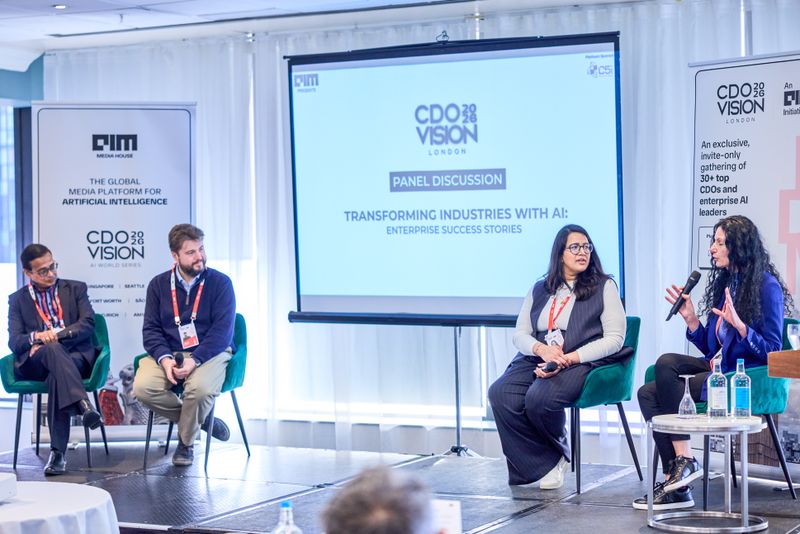
At CDO Vision London, part of the CDO Vision AI World Series, a global initiative spanning 22 cities that brings together senior data and technology leaders to explore the frontiers of AI-driven business transformation, London marked the series' fourth stop. A panel of senior data and AI leaders came together to explore how organisations are turning AI ambition into measurable enterprise impact.

Maria Stefanova
Head of PMO – Artificial Intelligence, International Airlines Group (IAG)
Bini Yoheswaran
Vice President - Data Excellence, choreograph
Sunando Das
Global Head of Predictive Analytics, Unilever
Chris de Gruben
Senior Director, Head of Property & PE, ArtefactModerated by Maria Stefanova, Head of PMO for Artificial Intelligence at International Airlines Group, the discussion brought together Bini Yoheswaran, Vice President of Data Excellence at Choreograph; Sunando Das, Global Head of Predictive Analytics at Unilever; and Chris de Gruben, Senior Director and Head of Property & PE at Artefact.
01Hype to business impact
For many organizations, the era of AI experimentation is giving way to something more demanding: making it actually work at scale. The panelists were united on one point , sustainable AI adoption begins not with technology, but with a clear business objective. As one global analytics leader put it, the question is never "where can we apply AI?" but rather "what problem are we trying to solve, and does AI help us solve it better?"
That distinction is reshaping how teams approach deployment. At one global personal care company, a programme spanning over 130 country categories was built around a specific commercial challenge , understanding performance across the classic six Ps of business , before any model was selected. At a major media and marketing group, agentic AI is being productionised to automate post-campaign analysis, compressing a labour-intensive process into a structured, repeatable workflow. Meanwhile, conversational AI layers are being added to existing analytical tools, allowing broader teams to query data without specialist support.
Generative AI is a powerful addition to that toolkit
- A replacement for it
02Data, people, adoption , the real barriers to scale
If there is one lesson that unites every AI programme at scale, it is this: the technology is rarely the bottleneck. The harder challenges lie on either side of it , in the messy reality of enterprise data and the equally complex task of bringing people along for the journey.
One panelist offered a striking breakdown of where time actually goes in a typical AI deployment: roughly 40% is consumed by data integration, just 20% by the modelling itself, and the remaining 40% by embedding the solution within the business. The middle phase , the part most people associate with AI , is, paradoxically, the fastest. It is the unglamorous work of data sourcing, standardisation, and stakeholder alignment that determines whether a project succeeds or quietly fades away.
Data challenges were a consistent theme across the discussion. Across global organisations, data arrives in different formats, at different frequencies, and from systems that were never designed to talk to each other. Governance frameworks are often absent or inconsistently applied, leaving teams to build on unstable foundations. Without clean, structured, and trustworthy data, even the most sophisticated model will underdeliver.
One panelist noted that focusing on frontline workers
- Just leadership metrics, is what drives genuine uptake
03When not to use AI
One of the more refreshing moments of the panel came when the conversation turned not to AI's potential, but to its limits. Not every problem, the panelists agreed, requires an AI solution , and pretending otherwise is one of the costliest mistakes an organisation can make.
A recurring observation was that basic data analytics or improved cross-team communication can resolve the majority of business problems, often at a fraction of the cost and complexity of an AI deployment. When leadership is dazzled by the technology rather than anchored to the objective, resources get misallocated and results disappoint.
There are also domains where human judgment simply cannot be substituted. In property, in marketing, in any field where emotional context and irrational human behaviour drive outcomes, over-automating risks stripping away precisely what creates competitive advantage. AI, one panelist warned, is a great leveller , it brings everyone to a baseline, but it rarely differentiates.
The risks extend beyond strategy. Organisations that have opened their data to early-stage startups are increasingly discovering uncomfortable consequences , from opaque data-sharing arrangements following acquisitions to governance gaps that expose sensitive information. The caution, as one panelist put it plainly, is to be careful who you let through the door. Not every shiny solution is worth the risk it carries.
04Building what lasts
The clearest signal from this discussion is that AI success is not a technology story , it is an organisational one. The companies pulling ahead are not necessarily those with the most advanced models; they are the ones with clean data, aligned leadership, and cultures willing to adapt. AI works best when it augments human judgment, not when it attempts to replace it. Get the foundations right , data, governance, people , and the technology will follow. Get them wrong, and no amount of innovation will save you.
CIO summit London · Compare this with our AI conference for CIOs.